Show nerves: settling the horse and the human
Your horse reads your heart rate through the reins. Calming show nerves is a two-animal problem, and you have to solve your half first.
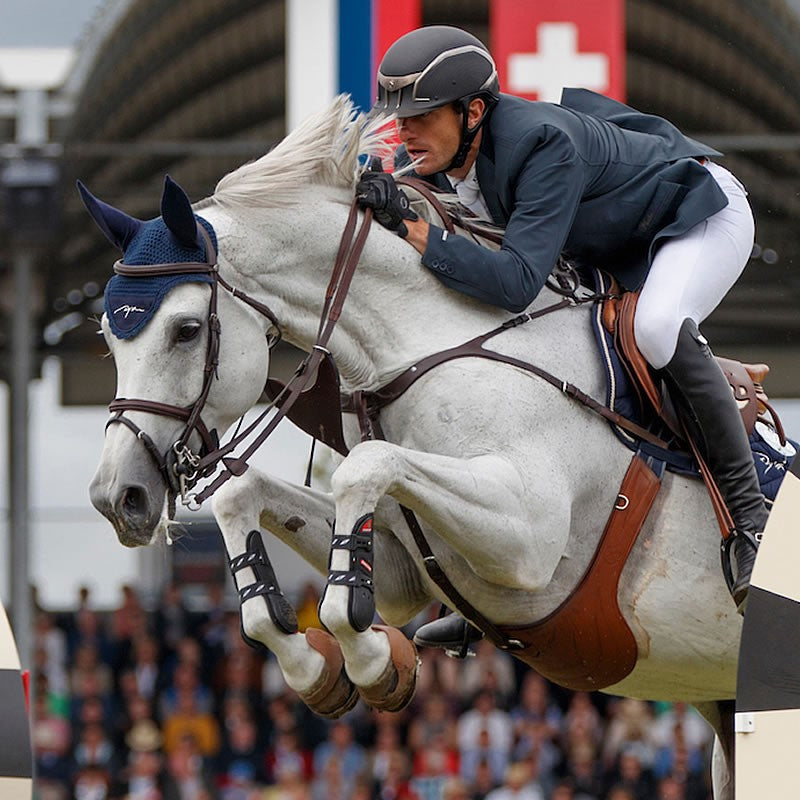
We've watched a steady old schoolmaster turn into a fire-breathing dragon at the in-gate, and the reason was sitting on his back. The rider's hands had gone hard, her seat had gone tight, and her breathing had climbed into her throat. The horse hadn't suddenly become nervous about the arena. He'd become nervous about the nervous person on top of him. That's the thing nobody tells you about show nerves: it's a feedback loop, and you control the input.
Horses are prey animals wired to read the emotional state of the herd. When your breathing shortens and your muscles brace, the horse interprets it the only way evolution taught him — something is wrong, get ready to leave. So the most effective calming technique isn't anything you do to the horse. It's regulating yourself first, because your calm is contagious in exactly the same way your panic is.
Start with the body, because it's faster than the mind. Long, slow exhales — out longer than in — physically lower your heart rate and unlock the death grip on the reins. Try humming or even singing quietly in the warm-up ring; you can't hold your breath and hum at the same time, and the horse feels the rhythm in your seat. Drop your stirrups and do a few minutes of walk on a long rein before anything else. If your jaw is tight, your hands are tight, and the horse knows.
The horse's nerves are usually a familiarity problem, and familiarity is fixable. Get to the grounds early and let him absorb the place before you ask anything of him. Hand-walk past the booth, the banners, the warm-up chaos. School the spooky corner repeatedly until it's boring. A horse who has already worked through the environment has nothing left to invent. Routine is the other anchor — feed, tack, and warm up in the same order you do at home, so even in a strange place the rhythm of the day tells him he's safe.
Preparation is its own sedative. The rider who has done the conditioning, knows the course or the test, and trusts the horse's fitness simply has less to fear, which is part of why we push the work in conditioning your horse for competition so hard for show-bound riders. Confidence isn't a feeling you summon at the gate; it's a memory of the work you already did. A horse that is fit and a rider who is prepared both arrive with a deeper well of calm to draw from.
Manage your inputs the way you'd manage the horse's. Too much caffeine turns ordinary nerves into the jitters. Skipping breakfast leaves you shaky and short-tempered by your second class. Stay off your phone and away from the rider in the warm-up who is broadcasting her own panic at full volume, because that loop is just as contagious between humans. Pick a quiet patch of grass, breathe, and run your plan once in your head.
Have a reset you can reach for when it goes sideways anyway, because sometimes it will. When the horse lights up, the worst response is to clamp down and hold your breath — that confirms his fear. Instead, exhale, soften your hand, put your leg on, and give him a simple job: a circle, a transition, something he knows. Work, done calmly, drains adrenaline out of both of you. Riders who freeze make it worse; riders who keep the horse busy ride it through.
None of this means the nerves disappear. Even seasoned competitors still feel them — the difference is they've learned the nerves are just energy, not a verdict. If this is your first time at a show, fold these tools into the broader plan in your first horse show survival guide, because a calm day is built on the boring preparation that came before it. Settle yourself, give the horse a job, and let the two of you talk each other down.