Working with a spooky horse without making it worse
You can't punish the spook out of a horse — you can only build the confidence that makes him stop needing it. Here's the patient, systematic way to do it.
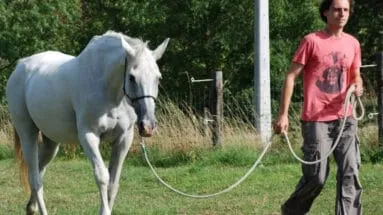
A spook is not disobedience. It's a prey animal doing exactly what kept his ancestors alive: react first, ask questions never. The owner who smacks her gelding for shying at a tarp has just confirmed to him that the scary corner is, in fact, a place where bad things happen. The horse who gets calmer is the one whose handler treats every spook as information rather than insult.
Consider a flighty off-the-track Thoroughbred mare named Etta whose owner was ready to give up. Etta spooked at umbrellas, plastic bags, the mounting block being moved, you name it. Eight months later she'd school past a flapping banner without flicking an ear. Nothing about that turnaround was magic. It was systematic exposure, the same principle behind any good desensitization program.
The foundation is solid groundwork, because a horse who reliably yields and disengages on the ground has an off-switch you can reach when his brain lights up. Before you introduce a single scary object you want the in-hand basics rock solid, the ones in groundwork every young horse needs, so that when adrenaline spikes you can ask him to move his feet with purpose and bring his thinking brain back online.
The technique itself is approach-and-retreat, and the discipline is in the timing. You present the scary thing at a distance the horse can tolerate — far enough that he's alert but not exploding. The instant he relaxes, even slightly, you take the pressure away by retreating or putting the object down. That release is the reward. Then you ask for a touch more: a step closer, the tarp rustled a little louder. You are constantly working the edge of his comfort, never blowing past it. Flooding — tying a terrified horse next to the monster until he "gets over it" — sometimes produces a shut-down horse, but just as often produces an explosion and a deeper fear. Patience genuinely is faster.
A few rules are worth never breaking. Work in a safe, enclosed space with good footing, because a horse processing fear will move his feet and you don't want a slick aisle or a loose gate in the mix. Read his honest body language — a high head, hard eye, tight muzzle, and held breath mean back off; a lowered head, a chew, a soft blink, a sigh mean he's processing and you can ask for a little more. Keep sessions short and end on a relaxed note, never on a fight. And separate genuine fear from testing: a horse who spooks at the same harmless object he walked past yesterday may be fresh and looking for an excuse, which is a leadership and energy-management problem, not a fear problem.
Some spookiness is physical, and good horsemanship means ruling that out. A horse who suddenly starts shying when he never used to may have a vision problem, ulcers, pain, or simply too much energy from too much grain and too little turnout. If the change is sudden or dramatic, loop in your vet before you assume it's all in his head.
Manage your own energy, too, because horses read it instantly. If you tense up and hold your breath every time you approach the scary corner, you've just told your horse there's something to fear. Breathe, soften your body, and ride or lead past with the same matter-of-fact confidence you'd use walking past a feed bucket. Your calm is contagious, and so is your worry.
The payoff for all this patient work shows up most on the trail, where you can't control what comes around the bend. A horse who's learned to look to you when something's frightening, rather than bolt, is the difference between a relaxing hack and a wreck, which is why confidence work and trail riding skills and safety go hand in hand. Build the foundation in the arena, prove it on the ground, and the spooky horse slowly becomes the steady one.