Teaching a horse to lunge, step by step
Lunging isn't running a horse in circles until he's tired. Done right, it's a conversation about voice, body language, and balance. Here's how to start a green horse correctly.
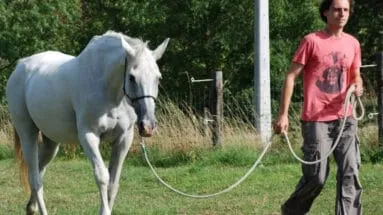
The most common lunging mistake is treating it as exercise instead of training. Someone clips on a line, chases the horse into a frantic circle, and calls it groundwork. What you actually get is a fit, anxious horse who's learned that the round pen means run. Real lunging teaches a horse to move forward, balance on a bend, and respond to your voice and posture from a distance — skills that translate straight to the saddle.
Before you start, the horse needs the in-hand basics: he should lead politely, stand, and yield to pressure. If those aren't solid, back up and build them first, because lunging on top of holes just magnifies them. The exercises in groundwork every young horse needs are exactly the foundation you want in place before the line ever goes on.
Set yourself up in a round pen or a fenced corner so the horse can't simply leave. You'll need a lunge line, a lunge whip used as an extension of your arm rather than a punishment, gloves, and a cavesson or well-fitted halter. Now work the steps.
1. Establish your triangle. Picture a triangle between you, the horse's nose, and his hip. The line runs to his head, the whip points toward his hindquarters, and you stay at the center near his girth. Your position drives everything.
2. Ask for walk first. Step toward the hip, raise the whip low behind him, and use a clear voice cue — a rising "waaalk." The moment he steps off on the circle, soften your posture and let him go.
3. Teach the voice, not the whip. Pair every transition with the same word every time: "trot" with an upward inflection, "walk" lower, "whoa" flat and final. Within a few sessions he'll respond to the word before you reinforce it with body language.
4. Keep him out on the circle. If he falls in toward you, lift the whip toward his shoulder and step toward it so he learns to maintain the bend and the size of the circle rather than spiraling in on top of you.
5. Practice the downward transition and the halt. Lower your energy, drop the whip tip to the ground, and ask "whoaaa," then reel him in calmly only after he's stopped and turned to face you — never let him decide the session is over by drifting off.
Keep early sessions short, five minutes per direction at most, and always lunge both ways evenly so you don't build a one-sided horse. Watch for fatigue and stress: a swishing tail, a gaping mouth, or a horse who can't hold the gait means you've asked too long, not that he needs more.
A well-started horse on the lunge becomes a tool you'll use for years — warming up a fresh horse, rehabbing a careful return to work, or simply checking soundness before you ride. It's also the safest place to introduce scary objects and build a horse's confidence at a controlled distance, which is the whole premise behind desensitizing a spooky horse. Teach it patiently, reward the smallest try, and you'll have a horse who reads your body from thirty feet away.